Antique Japanese Tantō Sword - Mumei, Shinshinto Era (22.4 cm)
¥400,000 ¥430,000

This blade has been acquired. Discover other exceptional swords currently available in our collection.


An NBTHK (Nihon Bijutsu Tōken Hozon Kyōkai) Hozon Tōken — its certificate the proof of both assured quality and historical value. This is a superb ubu (original-length), signed (zaimei) katana by Bishū Osafune Sukesada, a master of Bizen working in the late Muromachi period. A precious historical document carrying an Eiroku-era date (1565) cut on the reverse — from the very height of the Warring States (Sengoku) age — it is nonetheless freshly polished, nearly flawless, and exceptionally sound in both ground and edge. Its deep, beautiful 2.2 cm curvature and thick, substantial build preserve the shape of the period exactly as it was, boasting overwhelming beauty and impact.
Freshly polished, the blade is in extremely sound condition wholly worthy of the Hozon designation; in the interest of full disclosure, a few flaws and the trace of a forging blister (fukure) have been filled with patch metal (umegane). The jigane is an itame-hada, exceptionally well forged and packed, across which the faint midare-utsuri (undulating temper reflection) that is the very essence of Bizen rises in wavering form, moist and clear. The hamon is a notare-tinged suguha, breaking into ko-gunome around the monouchi (striking area). Within the edge run abundant ashi and yō, with ko-nie that make it bright and clear. The bōshi turns in as a midare-komi and returns firmly, without a single flaw. The tang (nakago) is ubu and unaltered, clearly cut on the front (omote) with the signature Bishū Osafune Sukesada and on the reverse (ura) with the Eiroku date — carrying the weight of history to the present day.
The sori stands deep at 2.2 cm, and both motohaba and sakihaba are solid, giving a thick, substantial build. The blade perfectly preserves the form of a sword of the late-Muromachi age of war, and the weight and dignified bearing felt when it is taken in hand are truly in a class of their own.
The Osafune school of Bizen province has been called the very "incarnation of the swordsmith," the single most prosperous lineage in the entire history of the Japanese sword. Among them, the Sukesada line that rose to fame in the late Muromachi period were masters who perfectly fused practicality and beauty, winning overwhelming support from warlords throughout the country. Blades like this one — meeting the harsh demand of the Sengoku era yet made with the very highest technique, and surviving in ubu, signed, and healthy condition — are exceedingly rare today, and are highly prized as emblematic of the beauty of Bizen swords.
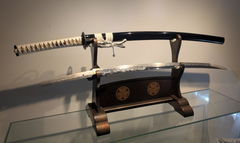
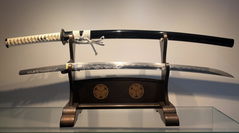
The sword is accompanied by a fine jidai koshirae of aged dignity and quiet composure. The hilt is finished in subdued brown cord wrap, and a round iron tsuba — pierced with a fine chrysanthemum-and-vine openwork against a subdued iron ground — provides an exquisite accent, evoking the refined aesthetic of the samurai. The black-lacquer saya retains an age-appropriate character, and the ensemble as a whole is in very good condition. In addition, a shirasaya for protection and storage is included (with a small chip to part of the horn).
A fine sword combining an Eiroku-dated ubu form that breathes the very air of the Sengoku era with an almost miraculous, near-flawless soundness. With its NBTHK Hozon certificate, a beautiful blade in which one can savor the essence of Sukesada, and a characterful period koshirae, it is a piece fully worthy of heading any collection.
¥400,000 ¥430,000

¥270,000 ¥290,000

¥300,000 ¥330,000


Every blade reflects generations of knowledge, discipline, and precision passed down through traditional Japanese swordmaking. From the forging of steel to the final finishing touches, each piece is shaped with patience, mastery, and deep respect for heritage.

From carefully selected materials to the refined finishing of every surface, each sword is crafted and presented with uncompromising attention to detail. Our commitment to authenticity ensures every piece reflects true tradition, lasting quality, and enduring cultural value.

Designed with balance, simplicity, and purpose, our blades embody the harmony between refined form and skilled craftsmanship. Each sword represents a thoughtful union of strength, elegance, and the timeless discipline of Japanese artisans.