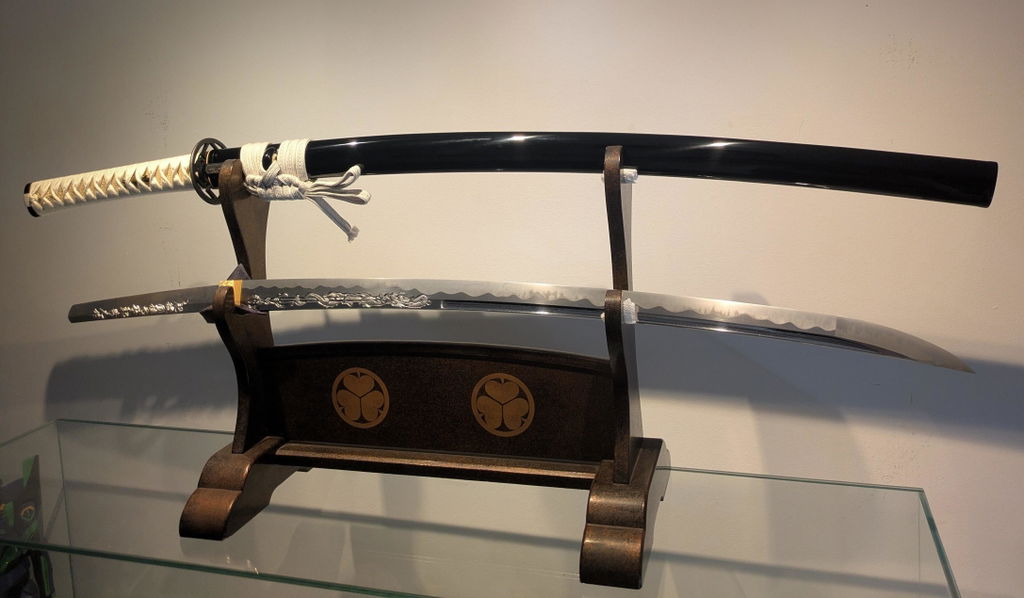
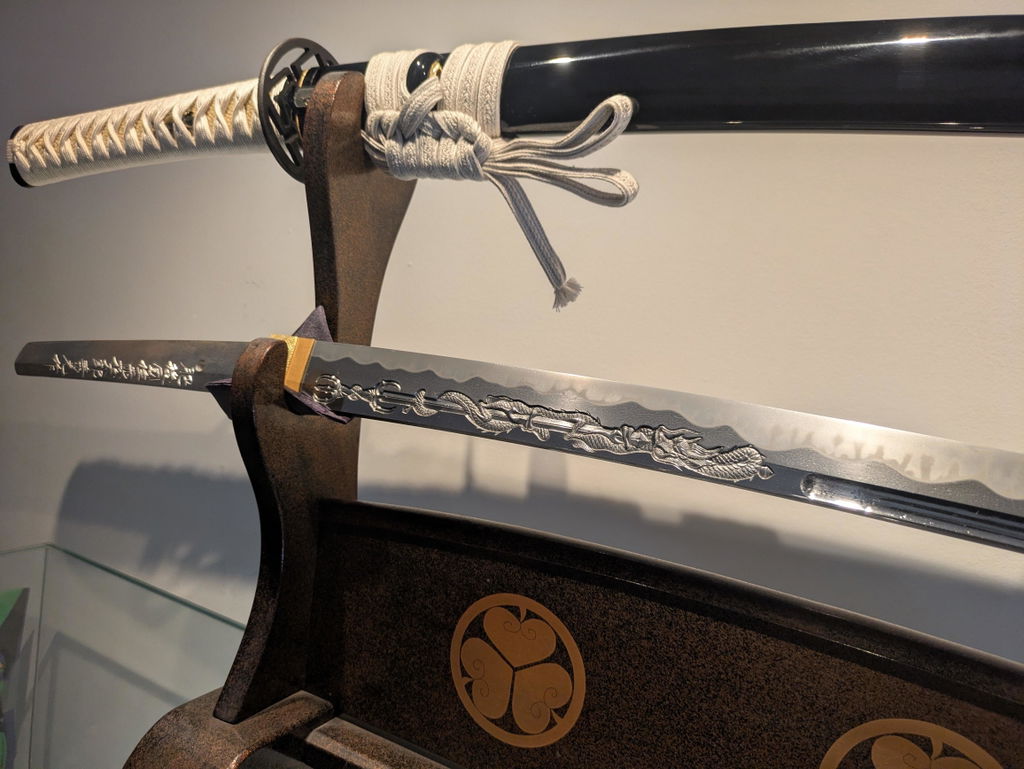
Antique Japanese Wakizashi Sword - Mumei, Shinto Era (36.6 cm)
¥200,000 ¥240,000

We present a superb tanto — plain and robust, yet full of dignity — by the master Kunisada, who forged iron in Aizu, Mutsu province, in the Kanbun era of the early Edo period, when the echoes of the age of war still lingered. It has the weighty form of a yoroidōshi (armor-piercing dagger), with a kasane reaching a full 8 mm, and a finely carved bō-hi run neatly along both faces. Into this blade, the resolve and practical beauty of the samurai are packed to the very limit, and it is accompanied by an elaborately designed carved-scabbard period mounting (kizami-saya jidai koshirae) with a fitted kozuka — a piece that conveys the very breath of history.
Though in an older polish, the carefully honed blade keeps very good soundness in both ground and edge. The jigane is a packed itame mixed with mokume, suggesting both the clear skin and the tenacity peculiar to the shintō period. The hamon is based on a bright, clear hoso-suguha (narrow straight temper) of ko-nie-deki, with fine ko-ashi and yō scattering gently along the edge — a quiet temper that conceals high technical skill. Despite an overwhelming kasane for its width, the bō-hi with rounded ends (maru-dome) carved through both faces gives it both good balance in hand and a refined, high-toned beauty.
What catches the eye at once is the extraordinarily weighty yoroidōshi form, some 8 mm thick. Built for grappling combat — to pierce the gaps in an opponent's armor at close quarters — it is an intensely martial shape, and yet the balance of its width and thickness, together with the carved grooves, lends it even a refined elegance. The taut tension peculiar to the early Edo Kanbun era overflows from the whole blade.
Kunisada was a smith active around the Kanbun era in Aizu, Mutsu province (present-day western Fukushima). Answering the demand of the samurai of his day, he sent many sturdy, keenly cutting, practical blades into the world. The shintō-era Aizu smiths were esteemed for the high-quality ground they achieved by carefully forging the hard iron of the northern country, and for a rugged yet beautiful finish that prized practicality — and this work, too, is a splendid piece that shows the true worth of the Aizu smiths.
The accompanying kizami-saya jidai koshirae is a set worthy of this commanding tanto, with a connoisseur's elaborate construction. Over the whole saya runs a delicate, well-balanced carved (kizami) pattern, and the deep, subdued flavor of its period lacquer gives it exceptional bearing. Especially notable is the hilt, finished in a magnificent sō-same-maki (full ray-skin wrap) in which large central nodules (oyatsubu) stand out — full ray-skin with oyatsubu was extremely costly even at the time, a status symbol of the owner's rank and of an exceptional devotion to his sword. The fuchi-kashira further bears a period-carved tengu design, carrying the strong protective meaning of warding off evil. Together with the deep antique patina of the fittings, it is a top-grade period koshirae of high appreciation value, distilling the samurai's spirit and aesthetic.
A hefty, combat-minded yoroidōshi such as this is a precious historical testament, conveying to the present the resolve and aesthetic of the Aizu samurai of the age. An overwhelming armor-piercing form, a beautifully carved bō-hi, an assured soundness within the old polish, and a period-rich carved-scabbard mounting — in it one can feel the warrior's passion left behind by the Aizu master Kunisada.
¥200,000 ¥240,000

¥400,000 ¥430,000

¥390,000 ¥410,000

¥270,000 ¥290,000

¥300,000 ¥330,000


Every blade reflects generations of knowledge, discipline, and precision passed down through traditional Japanese swordmaking. From the forging of steel to the final finishing touches, each piece is shaped with patience, mastery, and deep respect for heritage.

From carefully selected materials to the refined finishing of every surface, each sword is crafted and presented with uncompromising attention to detail. Our commitment to authenticity ensures every piece reflects true tradition, lasting quality, and enduring cultural value.

Designed with balance, simplicity, and purpose, our blades embody the harmony between refined form and skilled craftsmanship. Each sword represents a thoughtful union of strength, elegance, and the timeless discipline of Japanese artisans.