Antique Japanese Wakizashi Sword - Mumei, Shinto Era (36.6 cm)
¥200,000 ¥240,000

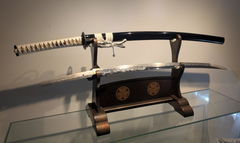
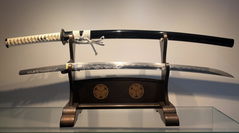
A sharp Kanbun-Shintō blade that blossomed in an age of peace and embodies the sword style of Shinkage-ryū and Ittō-ryū. Forged in the Kanbun era (circa 1661–1673) of the early Edo period — a time when shinai practice and kata training flourished and practical swordsmanship suited to swift draws and thrusts was being refined — this is an ubu, mumei uchigatana. Its shallow-curved, linear silhouette, with a strong contrast between motohaba and sakihaba, is the very essence of the "Kanbun Shintō."
In addition to the clean ji and ha of a blade that is nearly flawless and sound after polishing, it is accompanied by a complete period uchigatana koshirae: a very rare black-lacquered saya whose full, rounded, thick form clings to the hand; dragon menuki praying for success in life and the warding off of misfortune; and a sō-zame-maki tsuka a cut above the ordinary.
The jigane is an itame-hada (wood-grain pattern) beautifully mixed with flowing grain, with fine, thick ji-nie (steel martensite particles) laid on, showing a refined, clear surface.
The hamon is a gentle, irregular temper that rises from the yakidashi (start of the temper) in a relaxed notare (undulating line), softly mixed with ko-gunome (small irregular clove-shaped forms) and ko-midare. Bright, luminous ko-nie is laid deeply along the temper edge, soft ashi enter within the hamon, and sunagashi (sand-streak lines) flow as if drawing lines, making the activity of the ji and ha exceedingly rich. The bōshi (tip temper) continues in a midare-komi, turning back softly in a round shape at the tip.
After polishing, the blade is kept in a "nearly flawless and sound" condition with no chips or fatal defects, allowing one to fully appreciate the fine quality of its aged steel and its brilliant luster.
The nagasa (edge length) is slightly over 2 shaku 2 sun 1 bu (66.9 cm). The sori (curve) is extremely shallow at 0.4 cm, nearly straight, and the blade presents the dignified uchigatana form distinctive of the "Kanbun Shintō," suited to thrusting and swift draw-cuts. The motohaba of 29.3 mm and motokasane of 7 mm stand firm, while the sakihaba of 19.6 mm and sakikasane of 4.8 mm taper cleanly toward the point, emphasizing the drop in width between base and tip and drawing a sharp, keen silhouette.
At 660 g for the blade alone, it has an ideal weight for its width, easy to handle; and including the practical period koshirae (excluding the saya), the weight of 1,040 g offers an ideal balance that settles naturally into the hand.
The nakago (tang) is a flawless ubu tang that perfectly retains its length from the time of forging, with shallow katte-sagari file marks remaining at the kurijiri (chestnut-shaped end), and is covered in a deep, beautiful brown ubu-sabi (original patina) nurtured over the ages, eloquently speaking to its excellent state of preservation.
Unlike the flat saya of a typical uchigatana, this saya has a nearly circular cross-section and is fashioned in a very rare form with a full, rounded, thick volume throughout. The rich volume, which seems to envelop the blade gently, stands out, and its surface is elegantly finished in glossy black lacquer. Minute chips remain at the tip of the saya from long use, but these are the character of a genuine period koshirae that has survived long years. You may enjoy the atmosphere of history just as it is; and, if desired, we can also arrange repair of the saya by a craftsman.
The underlay of the tsuka (hilt) is a "sō-zame-maki," in which fine, even-grained white ray skin is wrapped over the entire hilt without gaps. It combines the practicality of preventing slipping from sweat and dramatically increasing the strength of the hilt with the beautiful rows of pearl-like granules visible through the gaps in the tsuka-ito, creating the luxury, a cut above, favored by high-ranking samurai.
The menuki are three-dimensional high-relief "dragons" with long bodies in motion, grasping a hōju (sacred jewel), with gold inlay at key points. Since ancient times the dragon has been a "water deity" and a guardian that wards off fire and misfortune, and, in its ascent to the heavens, the supreme auspicious motif symbolizing "success in life" and "victory and prosperity," earning the profound reverence of the samurai. The blade is fitted with a fine silver-ground habaki (blade collar). Free of showy ornamentation, the design reconciles robust simplicity with dignity.
The Kanbun era (1661–1673) fell within the reign of the 4th Tokugawa shōgun, Ietsuna. While a peaceful age took firm root, it was also a time when sword schools centered on shinai practice and kata training spread explosively among the samurai. The swords of this period changed from the earlier, imposing form that emphasized cutting in combat to a "straight-lined form with a shallow curve and a cleanly tapered tip," suited to thrusting and swift drawing. In the sword world this is called "Kanbun Shintō." This work gives dignified expression to the beauty of that era.
A Kanbun Shintō of dignified, taut form with a shallow curve, a calm notare with brilliantly clear ko-nie, and delicate sunagashi activity. The deep ubu-sabi on the ubu tang, preserved just as it was at the time of forging, speaks of a genuine quality that has passed through more than three and a half centuries without excess or deficiency.
The rich feel of a rounded black-lacquered saya that settles into the palm, a sō-zame-maki hilt pursuing both anti-slip function and sturdiness, and dragon menuki full of vitality symbolizing the pride of the samurai. For the minute chips at the saya tip, we also offer the option of restoration by a craftsman, so that this is a set that can satisfy both those who wish to enjoy the beauty of its age as it is and those who seek flawless appearance.
¥200,000 ¥240,000

¥400,000 ¥430,000

¥390,000 ¥410,000

¥270,000 ¥290,000

¥300,000 ¥330,000


Every blade reflects generations of knowledge, discipline, and precision passed down through traditional Japanese swordmaking. From the forging of steel to the final finishing touches, each piece is shaped with patience, mastery, and deep respect for heritage.

From carefully selected materials to the refined finishing of every surface, each sword is crafted and presented with uncompromising attention to detail. Our commitment to authenticity ensures every piece reflects true tradition, lasting quality, and enduring cultural value.

Designed with balance, simplicity, and purpose, our blades embody the harmony between refined form and skilled craftsmanship. Each sword represents a thoughtful union of strength, elegance, and the timeless discipline of Japanese artisans.