Antique Japanese Wakizashi Sword - Mumei, Shinto Era (36.6 cm)
¥200,000 ¥240,000

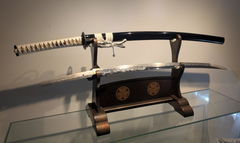
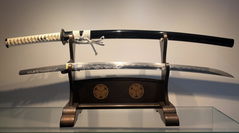
A rare and spirited custom-order blade by the "phantom master" Horikawa Kunitoku. Kunitoku was one of the very few direct disciples of Horikawa Kunihiro — the founding father of Shintō — to be permitted to bear the "Horikawa" name, and his surviving works are exceedingly rare. This blade is certified as Hozon Tōken by the NBTHK. In a distinctive kata-kiriha-zukuri form that carries the spirit of the Keichō–Genna eras, it bears a carved prayer to Dainichi Nyorai (Vaṃ), the supreme deity of esoteric Buddhism, and is accompanied by a period koshirae in full ray skin (sō-zame) that holds the resolve of the warrior.
The jigane is an itame-hada showing the bold, rugged "zanguri" surface distinctive of the Horikawa school, and a faint, whitish shirake-gokoro utsuri-like effect softly appears across the hiraji (flat surface), giving the steel an active, lively appearance. The hamon is a relaxed notare, its temper edge firmly covered with bright, clear ko-nie. Within the hamon, sunagashi and kinsuji work quietly, allowing one to fully appreciate the spirited ji and ha of the Horikawa school, which strongly retains the character of the Sōshū tradition.
The blade is thoroughly polished and nearly flawless and sound, with the ji and ha in extremely good condition. Though an old blade that has passed some four hundred years, it maintains a condition free of any breakdown.
The greatest appeal of this blade lies in its distinctive kata-kiriha-zukuri form, an old-fashioned style forged to the special order of a samurai during the Keichō–Genna period. This construction, with one side in kiriha-zukuri and the other in hira-zukuri, takes as its models the ancient straight swords and the work of Sadamune of the Nanboku-chō period, among others; it gives the blade abundant ha-niku (flesh at the edge) and brings an intense presence and practical beauty to the entire blade.
The nakago (tang) is an undamaged ubu tang retaining the form it held at the time of forging, pierced with three mekugi-ana (peg holes), and showing the rich, antique rust color of its age.
Horikawa Kunitoku was a swordsmith active in Yamashiro Province (present-day Kyoto Prefecture) during the Genna era (circa 1615–1624) of the early Edo period. A direct disciple of the great master Horikawa Kunihiro, the renowned founding father of Shintō, he is known as one of the few master smiths within Kunihiro's school who was specially permitted to bear the "Horikawa" name.
His style combines the rugged, standing-grain "zanguri" forging distinctive of the Horikawa school (Horikawa-mono) with the spirited energy of the Sōshū tradition. His surviving works are famously few. Though unsigned, this piece was appraised and attributed to "Horikawa Kunitoku" by the NBTHK, making it a precious blade in which the tradition and individuality of the Horikawa school are strongly expressed, and a historical document of the highest order.
Of further note is the refined, dignified religious carving cut into the base of the blade. On the omote (front), the bonji (Sanskrit seed syllable) "Vaṃ" (バン) is powerfully carved — the syllable symbolizing Dainichi Nyorai of the Kongōkai (Vajradhatu), the supreme deity of esoteric Buddhism and the truth of the cosmos — and beneath it is set, in orderly fashion, a renge-dai (lotus pedestal, with a hōju jewel motif), the sacred seat on which Buddhas are enshrined. This is a manifestation of the patron's deep faith, praying for lasting martial fortune and the absolute protection of the Buddha.
On the ura (back), a crisp, sharp bō-hi (single groove) is cut deep, tightening the weighty kata-kiriha-zukuri blade and creating a superb sense of tension and beauty.
The saya (scabbard) is finished in a base of black lacquer with a fine scattered-lacquer (chirashi-nuri) pattern that glitters like stars. Cracks are visible, yet a deep sense of luxury floats within its calm luster. The tsuka (hilt) is a lavish piece, covered across its whole underlay in sō-zame (full ray skin, with the granules left) and then carefully wrapped; the pronounced granules of the ray skin and the tsuka-ito together offer an exquisite feel in the hand and high durability.
The metalwork adorning the koshirae carries splendid designs evoking the education and stories of the samurai, brought together with a sense of unity. The tsuba is carved with a quiet grove of bamboo and a figure traveling on horseback, wearing a kasa (hat) — a scene of rich atmosphere, imbued with the refined aesthetic of an adult who appreciates elegant nature and the pleasures of the road. The fuchi-gashira finely depicts a man holding a bow, skillfully expressing the tension of the warrior house and the resolve of "one arrow, one life." The kozuka depicts three lions (sanjishi) — two glittering gold and one in refined black — in high-relief carving with gold inlay. Since ancient times, three lions have been regarded as a dignified auspicious design praying for "prosperity of the household" and "flourishing of the clan," and the interplay of gold and black colors beautifully expresses the harmony of "light and shadow" and "motion and stillness," as well as the composed spirit of a warrior.
Auspicious designs praying for lasting martial fortune and the prosperity of the family are concentrated throughout, and this is a koshirae of exceptional completeness, in which the patron's extraordinary dedication and high aesthetic sensibility can be seen. The blade is further fitted with a warm, gold-foil-wrapped double habaki (blade collar), which enhances the dignity of this fine blade.
A Hozon Tōken carrying the attribution to Horikawa Kunitoku, of whom very few works survive. Boasting the extremely rare form of kata-kiriha-zukuri with a bonji and lotus-pedestal carving, custom-ordered through a warrior's strong sense of beauty and faith, this blade has an overwhelming presence and individuality that will not be lost among any existing collection. A historic masterpiece worthy of being passed down for generations, it invites you to enjoy a luxurious moment of reflection on a master of the early Edo period and the passion of the samurai.
¥200,000 ¥240,000

¥400,000 ¥430,000

¥390,000 ¥410,000

¥270,000 ¥290,000

¥300,000 ¥330,000


Every blade reflects generations of knowledge, discipline, and precision passed down through traditional Japanese swordmaking. From the forging of steel to the final finishing touches, each piece is shaped with patience, mastery, and deep respect for heritage.

From carefully selected materials to the refined finishing of every surface, each sword is crafted and presented with uncompromising attention to detail. Our commitment to authenticity ensures every piece reflects true tradition, lasting quality, and enduring cultural value.

Designed with balance, simplicity, and purpose, our blades embody the harmony between refined form and skilled craftsmanship. Each sword represents a thoughtful union of strength, elegance, and the timeless discipline of Japanese artisans.